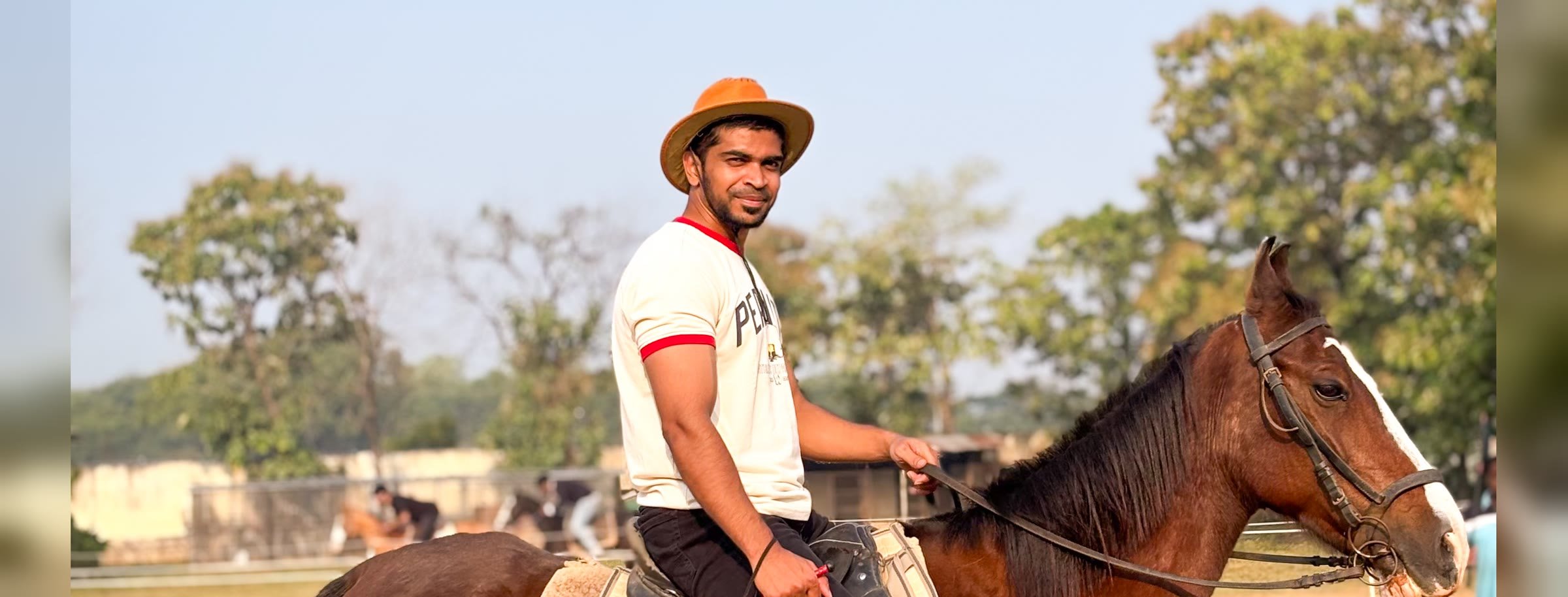
One Friday evening, on pure impulse, I decided to learn horse riding. By 7:30 the next morning, I was standing in the sand at the stable, sizing up a 500-kilo animal.
A month later, I’m out of bed before dawn six days a week, and I can’t remember the last time learning something was this humbling—or this much fun.
Going alone
The plan was to start with two friends. When their schedules fell through, I went on my own.
Walking in alone was harder than I’d like to admit. But years of training at the gym had already drilled one thing into me: nobody walks the path for you. Your curiosity is yours, and waiting for company is just a slower, polite way of never starting. If something feels right, don’t let being alone hold you back.
I went in planning to try a trial of weekend classes. I ended up signing up for the full month on the spot.
The basics
Fun fact from day one: when I asked why a class was only 30 minutes, my instructor laughed and said, “If you can last more than 30, I’ll give you a horse for free.” He wasn’t exaggerating by much. People assume you just sit back while the horse does the work, but holding your posture, bracing your core, and staying balanced takes far more out of you than it looks. By minute 25, you realize half an hour is plenty.
The first lessons covered the fundamentals. Approach a horse from the front, never the blind spot behind. Ride with empty pockets—no phone, no keys. (A few classes in, invest in your own helmet; it’s worth every rupee.) But one rule stuck with me above all: the horse goes where you look. Keep your eyes focused on where you want to head, not down at the ground. It works just as well outside the ring.
From bouncing to steering
The first ten classes were trotting—the horse’s bouncy jog—rising up and down in rhythm with the saddle while my instructor led. Trotting usually gives beginners a brutal lower-back ache. He asked if I was in pain three days in, fully expecting me to say yes. I wasn’t; lifting heavy at the gym had built the foundation.
What did burn was my knee grip. It lives deep in the adductors, and there are no shortcuts. You build it slowly, class by class, bruise by bruise.
The next five classes, I rode solo: steering, giving aids with my legs (the subtle nudges that signal what you want), and learning when to cue with the whip. It doesn’t work like turning a steering wheel. Some days the horse simply chooses not to listen. Sometimes tapping the whip makes it stop dead in its tracks.
The last five were the intense ones. They cured any lingering overconfidence. One morning the horse picked up speed and kept going—pulling the reins did nothing. The reins and stirrups began slipping through my hands. In the gym, you can muscle through a failed rep; on a horse, brute force is useless against half a ton of momentum. It eventually slowed down on its own, but hauling it to a complete stop took everything I had. It made one thing crystal clear: I don’t yet have the forearm and grip strength to control a horse under pressure. Humbling, and an unmistakable to-do list.
I started on Sweety and ride Gulaab now. Next comes the canter—a faster, rolling run—and hacking outside the ring. That’s another month or two of work.
The chargers at dawn
Part of what drew me to horses in the first place is Surah Al-Adiyat (The Chargers), chapter 100 of the Quran. It opens with an oath on horses:
“By the racers, panting,
And the producers of sparks [when] striking
And the chargers at dawn,
Stirring up thereby [clouds of] dust,
Arriving thereby in the center collectively.”— Surah Al-Adiyat, 100:1–5
Horses that run until they’re out of breath, strike sparks off the rocks and charge at dawn through the dust, straight into danger for the rider on their back.
Then the surah delivers the punchline: “Indeed mankind, to his Lord, is ungrateful.” (100:6). The word used is kanud: the one who counts his hardships and forgets his blessings.
That contrast hits me every time. A horse is given food and a little care, and it will run into danger for its rider. We’re given everything, and we still keep a list of complaints.
Standing in the ring at 7:00 AM, watching horses kick up dust in the morning light, I understand why they were worth an oath. When the alarm rings and my mind wants to complain about lost sleep, that’s kanud talking. Horse riding taught me to see the morning not as an inconvenience, but as a gift.
What the early start gave back
Getting up early wasn’t frictionless. Waking up on five or six hours of sleep after years of late nights stung. But having something tangible waiting at the stable made getting out of bed effortless.
The payoff ripples across the rest of the day:
- I eat on time. Two breakfasts: chocolate peanut butter oats before I head out at 6:30, and a real meal when I’m back at 9:30.
- Deep focus at work. My workday is sharper and more productive because I’ve already tackled something demanding before 9 AM.
- Quiet confidence. Riding alongside weight training and boxing builds a grounded discipline that carries into everything else.
The best part, though, isn’t just the ride. It’s the hour after. Banter and tea with my instructor and the other riders, surrounded by open air, miles away from city traffic. Everyone there is driven, fit, and grounded. That energy rubs off on you.
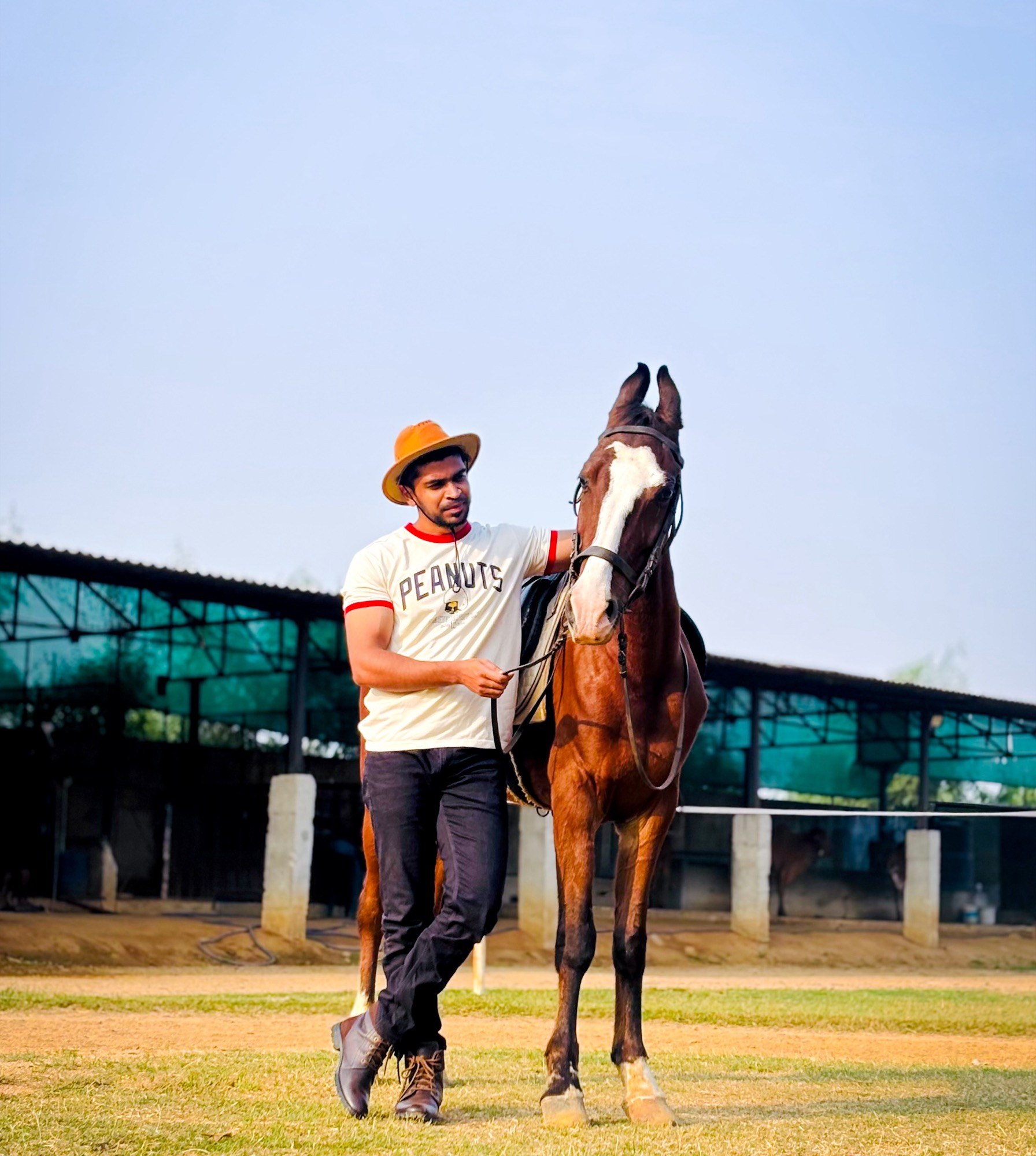
Mannat
One of the regular riders, a man in his forties, rides with an effortless grace that’s a joy to watch. Talking to him, I learned how profoundly animals help people navigate anxiety and depression. Whether horses or dogs, it comes down to unconditional presence, mutual trust, and knowing an animal relies on you.
My instructor embodies that. He’s been riding for nearly 30 years, and his care for animals extends far beyond horses—dogs, cows, sheep, birds, fishes. He lives simply, peacefully, and completely in tune with them.
Recently he bought a white horse named Mannat. White horses are prized, and she was a beauty. But she arrived sick. He had only had her for three or four days, but he poured everything into saving her: IV drips, medicines, round-the-clock attention. We watched how fiercely he fought for her.
One morning, we saw her resting before our session. By the time we finished our ride, she was gone.
It hit everyone hard, and him most of all. He’d lost an animal he cared for, along with a significant financial investment. Yet his composure never broke. He believed God had entrusted her into his hands, so he gave her everything he had. When she passed, he accepted it with calm grace—part of life, something that could happen to any one of us.
He didn’t turn kanud. He didn’t count it as an unfair hardship.
I keep coming back to that lesson: Do your part completely. Love what is in front of you while you have it. And accept the outcome without resentment.
What I’m taking with me
You might not like the conditions, but the horse doesn’t care. Execute anyway.
- Go alone if you have to. If an instinct feels right, don’t wait around for company.
- Look where you want to go. In the saddle, on the road, and in your goals.
- No shortcuts. Grip, balance, and poise are forged one session at a time.
- Do your part, then let go. The effort is yours. The outcome isn’t.
- Count your blessings, not your hardships. The horse charges into dawn. So can you.
Onwards
A month in, I haven’t regretted a single morning. Every class has challenged me, and every class has taught me something real.
Standing next to an animal ten times your weight has a quiet way of stripping away whatever ego you walked in with. You can’t fake competence, you can’t rush rapport, and you can’t muscle an animal that has its own mind. It humbles you down to your basics.
Stepping off the saddle, sore and dusty, you don’t feel proud. You just feel grateful to be there, healthy, and awake for mornings I spent years sleeping through.
Was this useful?

Senior Software Engineer at Confluent, based in Hyderabad. I write about building software and what I learn along the way. More about me